What is BotHearth?
BotHearth browses websites, works with files and saves results on your Mac, Linux host or VM. Connect a supported model account, describe a task, and take control when needed. Model access is separate.
The project is independent of OpenAI, Anthropic, Docker, and other providers mentioned in the documentation. Their names identify integrations or dependencies and do not imply endorsement.
What is ready in this release?
This site describes v0.0.1 alpha, with source and documentation reviewed on 2026-09-10. The documented installation path is a source build on macOS or Linux, with one operator and locally built computer images.
The repository includes automated checks for protocol, policy, daemon, packaging, and browser/container behavior. Review the actual CI runs and exact commit when evaluating a build.
Published packages and prebuilt images are not offered. The optional Mac shell is not notarized. Provider compatibility, automation rules, hardware differences, and model behavior need testing in your own environment. Read the current limits.
How can I help?
Try a small reproducible task and report the result. A clear issue with the expected behavior, actual behavior, commit, OS, runtime, model connection, and safe reproduction steps is more useful than a broad feature request.
For code changes, read CONTRIBUTING.md, the contributor agreement, and the licence first. Keep a change focused. Run the checks relevant to the code, include a reproducible failure when fixing a bug, and document changes to behavior or trust boundaries.
npm ci
npm run build
npm run typecheck
npm run lint
The full test instructions are in the contribution guide. Computer-server unit checks use their own dependency install; container integration checks need built images. Share sanitized logs only. Report vulnerabilities privately.
Screenshots and credits
Explore the BotHearth source repository for the program, installation instructions and licence terms.
The homepage and README show the real Gmail organisation test recorded on 8 September 2026. Private account details and obsolete interface text are blurred. The task and results are real.
The test took 51 min 6 s across two runs: the first ran for 30 min 17 s before a legacy timeout; the continuation completed in 20 min 49 s. The completion image below shows that final run. Across both runs the task report records 18 new filters; the final run reports 21 conversations archived and a saved gmail-organised.md report. These are observed test results, not a speed or accuracy guarantee.
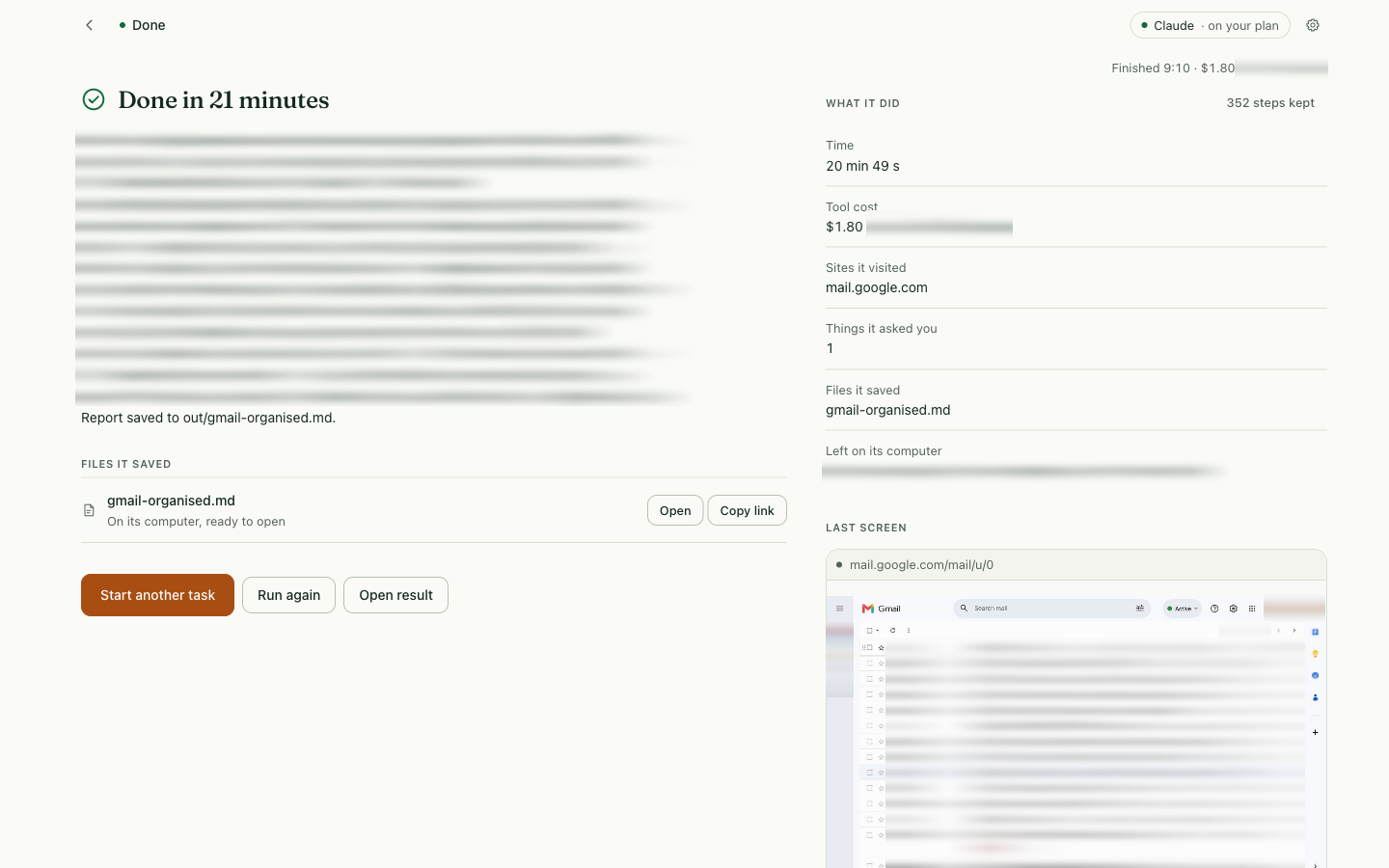
The recorded tool-use estimate was US$5.13 across both runs, including US$1.80 for the final run; it is not a measured provider bill. Browser profiles and files live on your host. Read the usage-meter explanation.
The site uses locally served Fraunces under its SIL Open Font License, system interface fonts, and a small vector hearth mark. Dependencies keep their own licences and notices; see third-party notices.
Project software is source-available under PolyForm Noncommercial 1.0.0. The trademark policy applies to names and branding. The additional business permission allows one free business bot and commercial outputs; standard grants exclude reselling or hosting copies of the service. An optional work-domain certificate records the organisation’s free allowance.